
2025 is a year of changes for the Aged Care industry. These changes will impact Elders and our organisation. Our objective is to support you best we can as we navigate these changes together. We are here for you, and aim to make all transitions as smooth as possible. Below we have broken down some of the key components of the Government’s changes to Aged Care and what they will mean for you.
Introducing the Support At Home Program
The Support at Home Program will commence 1st July 2025, and will replace the Home Care Packages Program and the Short-Term Restorative Care Programme. The funding model for the program will be activity based, and feature 8 funding classifications and separate subsidies for the ‘End of Life Pathway,’ and ‘Restorative Care Pathway.’ There is a defined service list, and you can click here to find out more about what services are available under Support at Home.
For those who will be transitioning from the Home Care Package, their subsidy will remain at their existing HCP level. If Elders are transitioning from the Home Care Package to Support at Home with unspent funds, these funds will not be removed and can still be used on services.
What changes will you notice?
Service Approvals
One change we predict our community will be impacted by is that services will only be provided if approval has been obtained. This has eliminated some of the flexibility we had as a service provider to approve services. Should an Elder’s needs change and they need to implement new services, they must be reassessed by the assessment agency to obtain approval. With the change, there is also the separation of Assistive Technology and Home Modifications as their own funding streams, the budget for which can be viewed in the Support at Home Program handbook.
Accruing Limits
Under Support at Home, Elders are not able to accrue subsidy funding over $1000 or 10% of their 3-month budget to be carried over to the next quarterly period.
Client Contributions
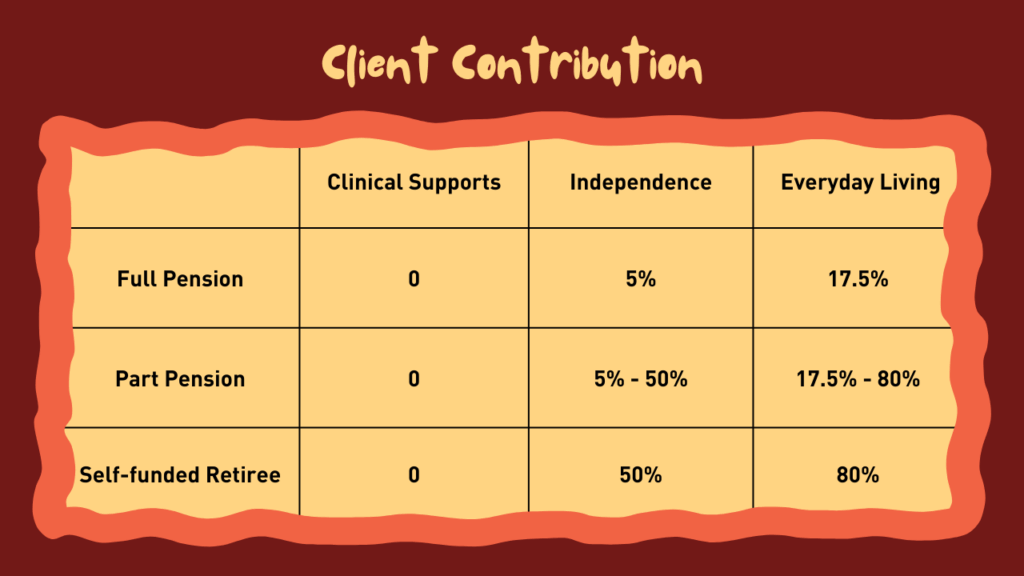
As a standard practice across the aged care sector, the Individual will also be required to pay a client contribution which we know may put financial strain on Elders – to find out more about client contributions and how they will impact you follow this link. The Client contribution amount will be determined through means testing, and the Individual will only pay contributions on the services they have received.
The Department explains, “A no worse off principle will apply to the contributions arrangements for people who, on 12 September 2024, were either receiving a package, on the National Priority System, or assessed as eligible for a package. These participants will be no worse off because of the reforms: they make the same contributions, or lower, than they would have had under Home Care Package (HCP) Program arrangements. If you are a full rate pensioner paying no fees under your HCP as at 12 September 2024, you will never pay fees under Support at Home.”
More levels of Care
Under current Home Care Packages aged care classifications are split into 4 levels, under Support at Home Program there will be 8 levels. To view the quarterly budget for each Support at Home classification and a comprehensive explanation of the Program, please see this handbook released by the Department of Health and Aged Care.
What will my aged care look like under the Support At Home Progam?
Available Services
The Support at Home Service list can be accessed through this link.
Paying a Client Contribution
The new Support at Home Program requires a client contribution for services. Contributions will be calculated on a rate per hour or unit cost at a set percentage of the prices for each service and determined through means testing.
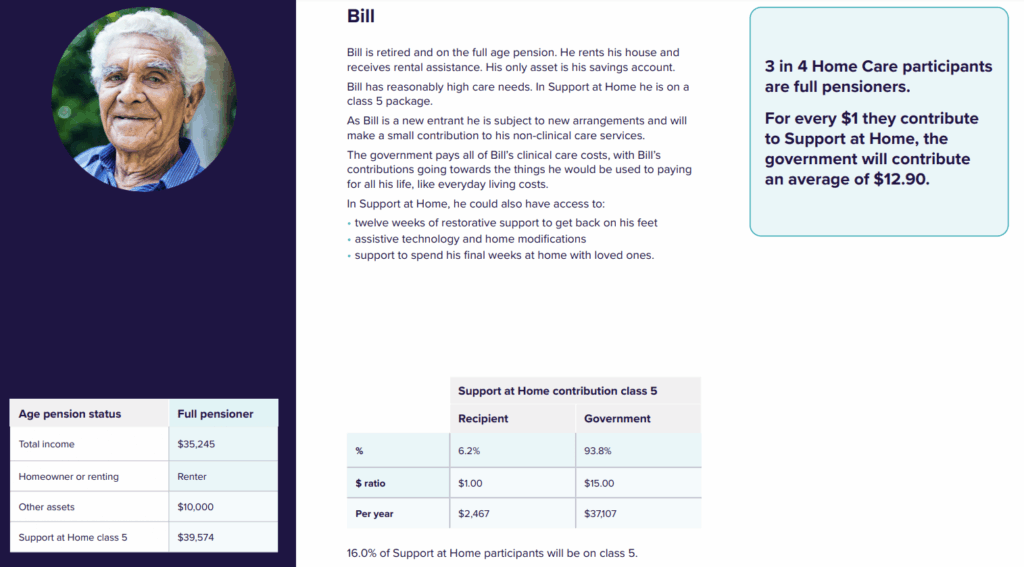
The case study below was created by the Department to illustrate how this charging would work for clients like Bill on a full pension. This represents a large majority of our clients when factoring in those on a full disability pension, assuming – until further notice from the Government – that the same rules will apply.
What actions are we taking to transition smoothly?
As a provider we are restructuring our entire organisation to suit the provision of the new program and maintain compliance. We know the new program will be a difficult change for Elders, and we will be advocating for more appropriate legislation when it comes to Aboriginal and Torres Strait Islander aged care. We ask that Elders keep in mind that our objective is to support you as best as possible, and that Coordinators are working very hard to adapt to the new legislation.
Creating new Models of Care
ACS is investigating a variety of new models of care and awaiting final information on the program and legislation, so we can continue to provide appropriate care to Elders. We will provide updates on our model of care and how any changes will effect you.
Staff Training
With the release of new aged care standards as a part of the reform, all staff have begun mandatory training. We have fostered a culture of enthusiasm surrounding the new standards by completing team training, setting up displays, celebrating staff learning on our office screens and across our media channels, and holding competitions to further engagement.
Advocacy
We are also engaging in advocacy for Aboriginal and Torres Strait Islander Elders through our involvement with NATSIAAC. Read more about NATSIAAC at natsiaacc.org.au
Our take on the new aged care changes
Aboriginal Community Service is saddened by the fact we must now charge our community with Client Contributions. In the past we were able to advocate for an exemption from the Government based on the fact that…
- ACS is an Aboriginal Community Controlled Organisation, established by community for community
- ACS is “not for profit” entity and has a “charity” status
- ACS believe that Elders should not be denied a service because they cannot afford to pay for a service
It is clear to us that the changes set by the government will have a disproportionately negative impact on Aboriginal and Torres Strait Islander Elders.
The Government states that the aged care reforms including the new Aged Care Act and new Support at Home program are designed to improve the “rights” of the older person, but many of our Elders will be disadvantaged by the changes that have been described.
Professor Kathy Eager, an Australian clinician and health services academic, commented publicly on the reforms, explaining, “The government proposes a massive increase in consumer charges, expecting providers to collect these payments, (…) If consumers cannot pay, providers face the dilemma of delivering unfunded services or ceasing care altogether. This creates a significant financial strain and jeopardizes service quality.”
As a provider to regional and remote communities, the reforms place us in a particularly precarious position. The reforms seem to be in direct contradiction to many of the recommendations of our peak body, the recent Interim Commissioner’s Report, and the findings of research around Aboriginal and Torres Strait Islander Aged Care. It is so important, that while the Department refuse to prioritize equity in the Aged Care System, that an Organisation like ours continues to function as a culturally appropriate provider who value the physical, social and emotional health and wellbeing of Aboriginal and Torres Strait Islander Elders.
We plan to continue advocating for Elders, through liaising with the National Aboriginal and Torres Strait Islander Ageing and Aged Care Council, and sharing information about Aboriginal and Torres Strait Islander Aged Care through various channels. Please continue to check the updates section of our website for more information.